
How Many Points Should You Average When You, Personally, Are Serving?
Place Your Bet Now!

It’s 0-0-2, and you are serving. If you have a 50/50 chance of winning the game, and all four players are about equal in skill, how many points should you have when you have to relinquish the serve?
If you said “eleven”, that’s a Golden Pickle, and the approximate odds of achieving a Golden Pickle are about 1 in 7,800.
For the rest of us? Here is a frequency distribution of points scored.
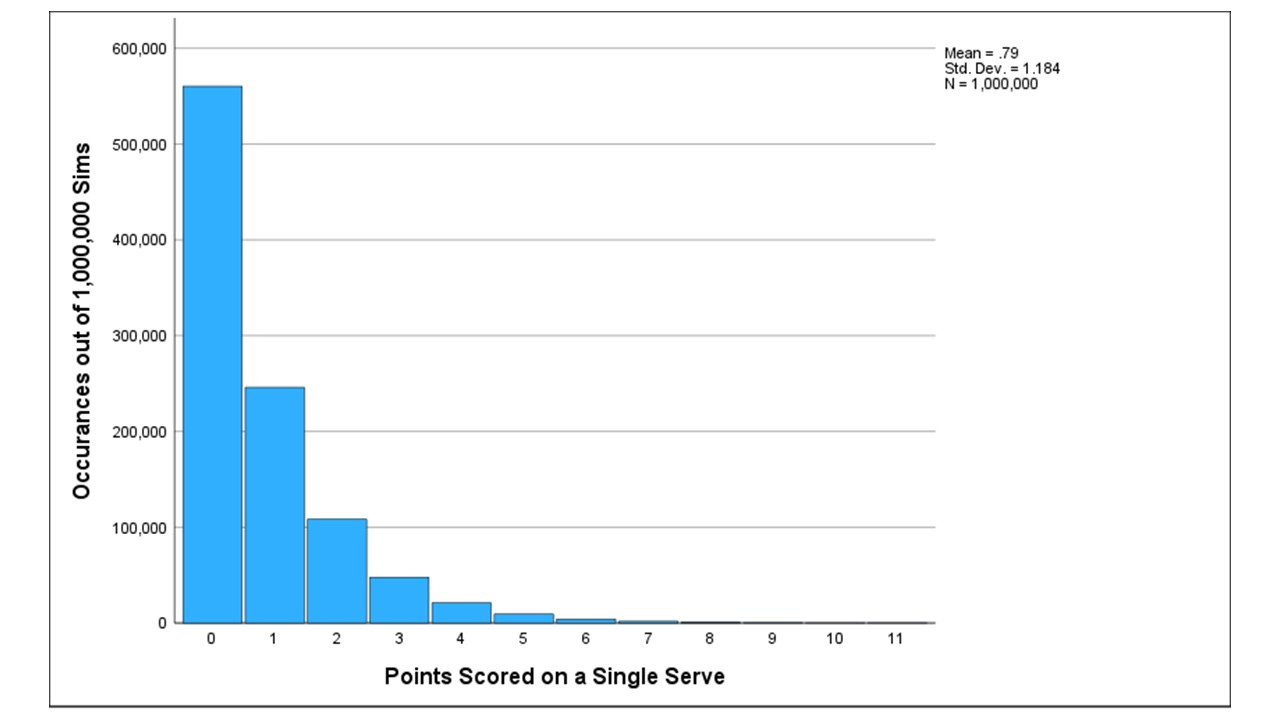
Most of the time you don’t score. About a quarter of the time you score one point, about 11% of the time you score two points, about 4% of the time you score three points.
The average? 0.79 points. Which means when both you and your partner get to serve you should expect 1.58 points.
Interestingly (and predictably), the better the probability of scoring a point, the higher outcome one can expect on points scored while serving.
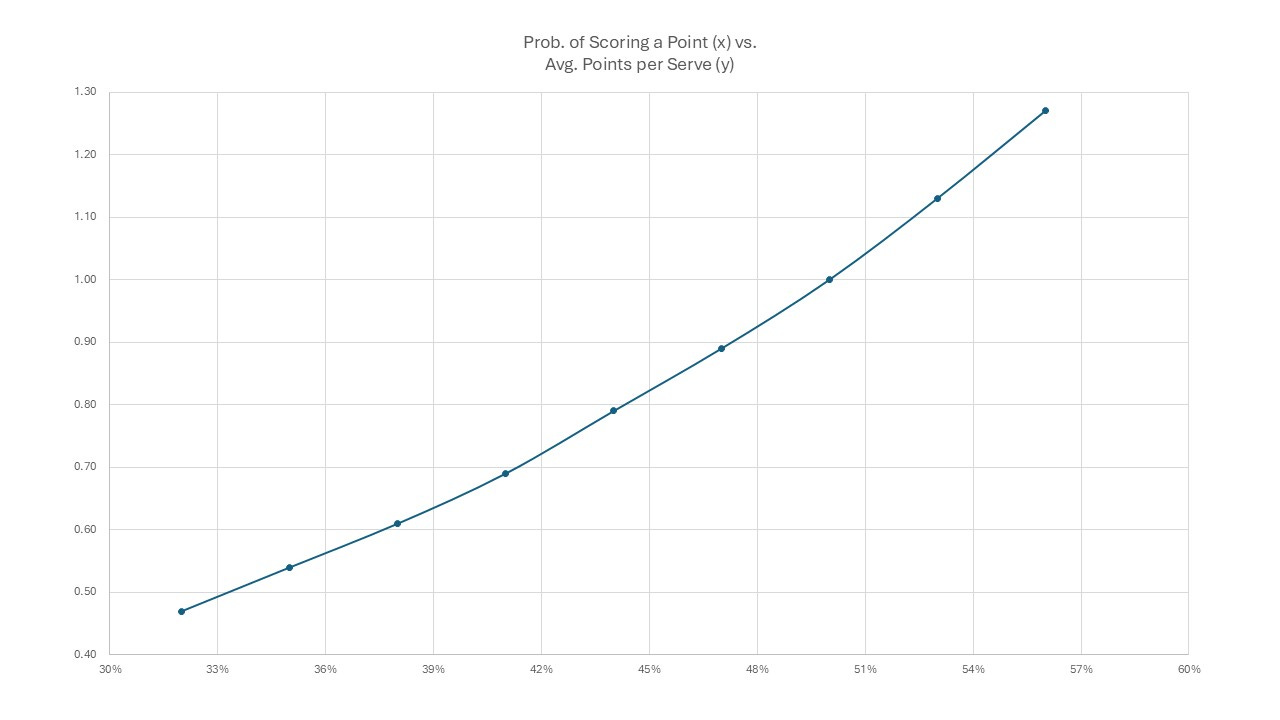
The x-axis is the probability of scoring a point.
The y-axis is the amount of points you can expect when you serve.
The higher your odds of scoring a point, the higher your expectation of points scored - and the relationship increases faster as your probability of scoring a point increases.
In other words, if you do the little things … keep balls in play (especially on third shots), have a heavy serve to backhands etc., your probability of scoring a point increases at an ever-increasing rate.
When I was learning the game (2018-2020), I was complimented for hitting third shot drops into the net … people liked the fact that I was trying to develop a soft game. This was incorrect. What people should have done is praised me for simply getting the ball over the net!
Think about it this way. Let’s assume that you attempt 9 third shots, scoring an average of 50% of the time, but you hit the 10th third shot into the net. You will score on 45% of your points … but the one ball you hit into the net is a rally killer that prevents you from scoring.
Meanwhile, your opponent attempts 9 third shots, scoring an average of 48% of the time (worse performance than you), but hits the 10th third shot too high, leaving you with just a 25% chance of scoring a point. Your opponent will score on (0.48*9 + 0.25*1)/10 = 45.7% of your points. Your opponent isn’t as good as you are, but because your opponent gets the ball over the net the opponent is more likely to score than you are … meaning your opponent is more likely to beat you … even though your opponent is likely worse than you are.
Get your thirds/fifths over the net. You might find that you go on more runs as a consequence.
Kevin — love this breakdown. Your math always exposes something players feel but can’t articulate. That 0.79‑point average per server is such a useful anchor for rec players who think every missed third shot is the end of the world.
As a pickleball instructor down in Florida, I see your core point every day: the player who simply gets the ball over the net wins more rallies than the player who’s “trying to play the right way.” Your example nails it — a technically “worse” player who keeps the ball alive is more dangerous than a “better” player who gifts one rally‑killer.
Your work pairs beautifully with what I teach about middle‑ball clarity and functional thirds. Players don’t need magic; they need fewer self‑inflicted wounds.